
O2 & Starlink Direct to Cell Explained
THE END OF MOBILE DEAD ZONES
A NEW ERA OF CONNECTIVITY
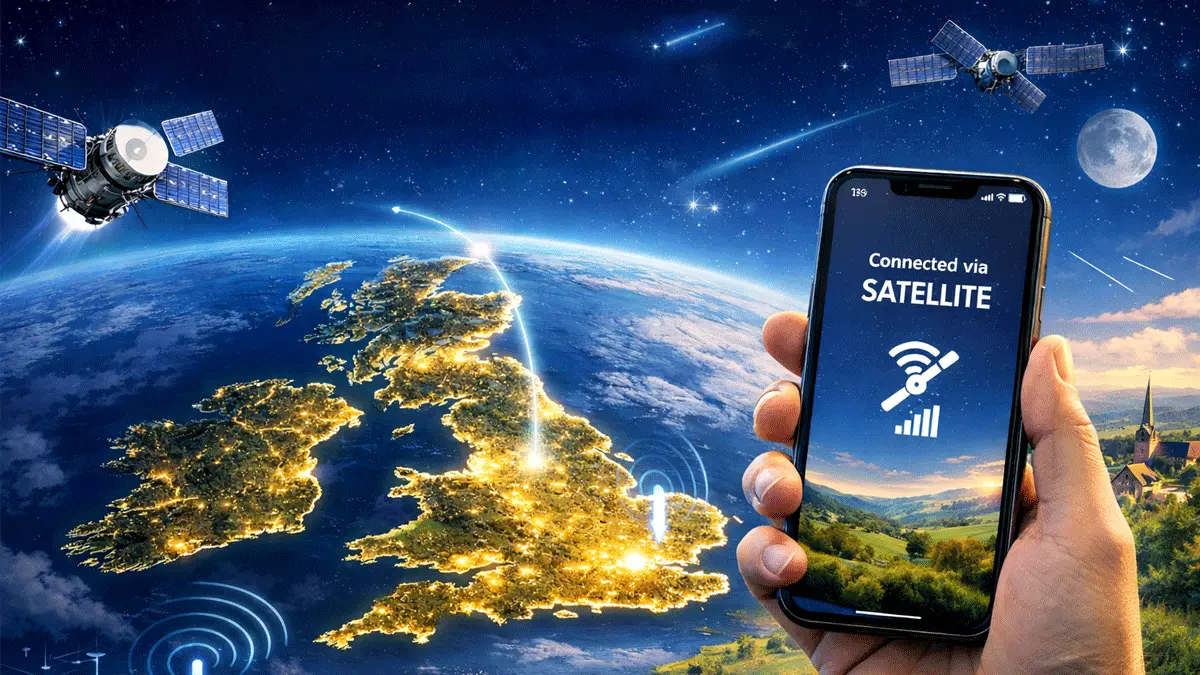
Losing phone signal in the countryside has always felt like an unavoidable fact of life. You step off the beaten track and your connection vanishes. But as of late February 2026, the game has fundamentally changed. Virgin Media O2 becomes the first UK mobile network to switch on direct to device satellite connectivity with the launch of O2 Satellite.
By leveraging SpaceX's Starlink network, this launch does not just fix a few local black spots. It is a massive proof of concept that signals the end of mobile dead zones entirely. While the UK is the first in Europe to get this live, the rest of the world will be watching closely.
THE BREAKTHROUGH: CLOSING THE GAP
Before this rollout, Virgin Media O2 covered about 89% of the UK landmass. That left huge chunks of rural, coastal, and remote areas known as "not-spots". By switching on O2 Satellite, that coverage has jumped overnight to 95%.
- Massive Scale: The extra coverage is roughly equivalent to two thirds the size of Wales.
- True Resilience: It acts as an emergency safety net. If a local cell tower goes down due to a power outage or severe weather, your phone will simply route through space instead.
HOW IT WORKS
What makes this system brilliant is its simplicity. You do not need to download a separate application or buy a bulky satellite dish to carry around in your rucksack.
Starlink's low-Earth-orbit satellites are essentially acting as cell towers in space. They use O2's licensed mobile spectrum to beam a connection directly to standard smartphones. When your handset detects that standard terrestrial signalling is gone, it automatically hands over to the satellite network.
At launch, it supports text messaging and mobile data for critical applications. This means you can still use WhatsApp, Facebook Messenger, Google Maps, and check weather apps while travelling through remote terrain.
COMPATIBILITY: WHO GETS IT FIRST?
| DEVICE LINEUP | SUPPORTED APPS | STATUS |
|---|---|---|
| Samsung Galaxy S25 Series | WhatsApp, Maps, Messenger, Weather | Live Now |
| Other Androids & iPhones | TBC | Rolling Out Soon |
Note: To get connected, you will need a Samsung Galaxy S25, S25+, S25 Ultra, or S25 Edge. Virgin Media O2 has stated that broader device and manufacturer support is coming very soon.
THE PRICING
Adding space-age technology to your phone bill could have been extremely expensive. Fortunately, the pricing structure is very straightforward.
- Pay Monthly Customers: Available as a £3-per-month bolt-on. You can add or remove it as needed.
- Ultimate Plan Customers: The service will soon be included at absolutely no extra cost for those on the highest tier.
THE GLOBAL IMPACT
Why does a network upgrade in the UK matter globally? Because it proves that satellite to smartphone connectivity is commercially viable right now. By navigating Ofcom's regulatory hurdles and securing the first licence for satellite to smartphone services, the UK has created a template for telecom operators worldwide.
As Stephanie Bednarek, VP of Starlink Commercial Sales noted, delivering this technology underscores the importance of keeping people connected anywhere on the planet. This is the first ripple of a tidal wave that will eventually make finding a phone signal a thing of the past, whether you are hiking in Scotland or off-roading in the outback.
FAQS
WHICH PHONES WORK WITH O2 SATELLITE?
At launch, you need a device from the new Samsung Galaxy S25 family. More manufacturers are expected to be supported very soon.
DO I NEED A STARLINK DISH?
No. Direct to Cell technology connects the satellites in space straight to the internal antenna of your standard smartphone. No external hardware required.
CAN I WATCH VIDEOS OR BROWSE TIKTOK ON IT?
Not initially. The system is focussed on keeping you connected for essential communication. Right now, it handles text messages and lightweight app data like Google Maps and weather updates.
VERDICT: IS IT WORTH £3 A MONTH?
Rural Residents? ✅ Absolutely. It gives you peace of mind in areas standard towers ignore.
Outdoor Enthusiasts? ✅ Yes. A safety net for hikers, climbers, and sailors.
City Dwellers? ⚠️ You probably don't need it unless you travel off-grid frequently.